

Hardware Reviews
ATi HD 6990 - Review
Aaah, it's Monday morning, 9AM - with a cup of coffee in my right hand staring at the monitor, looking outside through the office window where there is a clear blue sky and the sun is shining. Sitting 3 meters away from me is "Diablo" our primary mean graphics benchmarking machine, sitting in it, is this red little devil armed by two GPUs and a lot of features. Heck yeah, last week the Radeon HD 6990 arrived here in the office, and is sitting like two buns in an oven waiting to be consumed. It's gonna be a good day.
Radeon HD 6990 ladies and gentlemen is AMD's latest ATI Radeon HD dual-GPU based graphics card. And for now it will be the fastest 'single' graphics card available on the planet. The performance numbers you will see are anything short from astonishing, breathtaking stuff for a wicked product.
For many weeks now the Radeon HD 6990 has been a product of much discussion. Nobody really could confirm what GPUs would be used, how much graphics memory it would get and so on. Well, rest assured. AMD stuck two Cayman XT GPUs (R6970) onto the PCB and allows them to be clock at R6970 speeds as well, in fact you'll get options in clock-frequencies and TDP with the help of a small micro-switch seated on the card, which leads to 2 vBIOS, one with more acceptable TDPs and the other enabling a higher clock frequency mode. Now I've stated it, Cayman XT GPUs, that means the full shader processor count inside that GPU is available, that sums up towards 3072 shader processors (!)
Memory wise, AMD decided not to skimp here either, the Radeon HD 6990 is a card that will be perfectly suited for Eyefinity solutions, say 3 to 5 monitors PER Radeon HD 6990. In such setup it's wise to have a little more memory per GPU, especially with stuff like high anti-aliasing levels in mind. As such the Radeon HD 6990 comes with a flabbergasting 4 GB of graphics memory, that's two GB per GPU.
All in all, we'll have a lot to talk about today, we'll have a quick chat about verbs like Barts, Cayman and Antilles, then we'll describe the architecture a bit better, we'll have a close look at the products with the help of a photo-gallery ... and well that's all followed by power consumptions, heat levels and performance measurements of course.
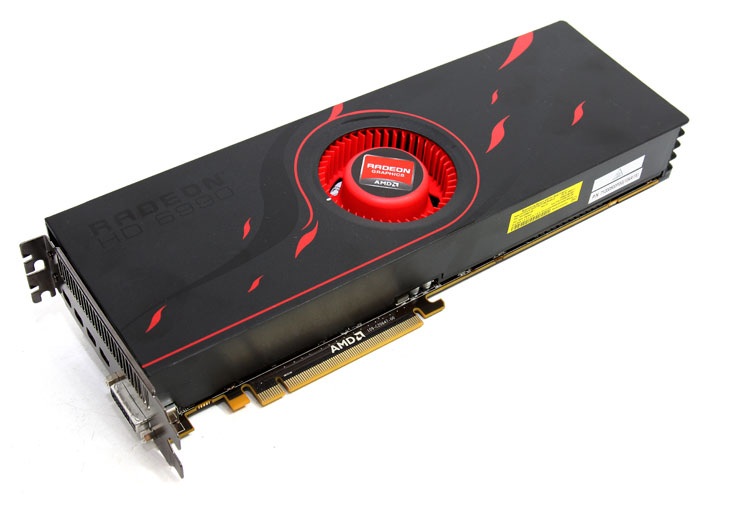
The Radeon HD 6990 comes armed with an astonishing 3072 shader processors, thus 48 SIMD based shader clusters, split up in a twofold engine per GPU. The domain and shader clock is locked in at 830 or 880 MHz. The card comes paired with 4 GB of memory clocked at (effective) 5000 MHz (2GB per GPU). The TDP of this product is 350W in default mode, and in unlocked mode the card can consume 415W with a hefty game. There's room left for overclocking in the unlocked design though, you may take the card up-to roughly 450W.
Now, since we have all this knowledge let's just compare this product with some others. Let's have a quick comparative overview of some of the specifications representing a certain scope of other performance parts, you'll notice that the differences are just HUGE, I've inserted the 'default' performance mode in there, not the unlocked one :
| Specifications | Radeon HD 5770 | Radeon HD 5850 | Radeon HD 6850 | Radeon HD 6870 | Radeon HD 6950 | Radeon HD 6970 | Radeon HD 6990 |
| GPU | Juniper XT | Cypress Pro | Barts Pro | Barts XT | Cayman Pro | Cayman XT | Cayman XT |
| Manufact. tech. | 40nm | 40 nm | 40nm | 40nm | 40nm | 40nm | 40nm |
| GPU frequency | 850 MHz | 725 MHz | 775 MHz | 900 MHz | 800 MHz | 880 MHz | 830 MHz |
| Stream processors | 800 | 1440 | 960 | 1120 | 1408 | 1536 | 3072 |
| Memory Datarate | 4800 MHz | 4000 MHz | 4000 MHz | 4200 MHz | 5000 MHz | 5500 MHz | 5000 MHz |
| Memory bus | 128-bit | 256-bit | 256-bit | 256-bit | 256-bit | 256-bit | 256-bit x2 |
| Memory buffer |
1 GB GDDR5 | 1 GB GDDR5 | 1 GB GDDR5 | 1 GB GDDR5 | 2 GB GDDR5 | 2 GB GDDR5 | 4 GB GDDR5 |
| Power consumption |
108W | 151W | 127W | 150W | 150W | 190W | 350W |
| Idle Power |
- | - | 19W | 19W | 20W | 20W | 37W |
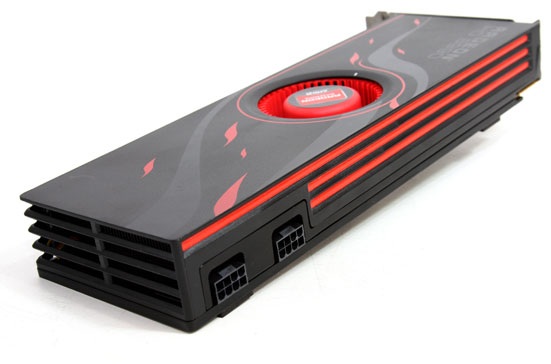
Aaah, as an actor from the TV series Friends once said in peace and tranquility, Unagi. The Radeon HD 6990 is a very impressive card. And for this conclusion we have a lot to talk about. So with the very short time we had available to make this article, we hope it was an intersting read. First off, products like the one shown today are always trivial to recommend and most of all, explain. They are expensive and they perform at a level that hardly anyone requires let alone needs. Still that doesn't change the fact that within it's segment and audience, the most high-end cards are desired by a lot of you. Whether it's just to gain a humongous e-peen, an x-factor product or you simple have a desire for the best gaming performance, it's these people that will purchase the Radeon HD 6990, yeah it is a very impressive card. For the people that like to setup more than one big monitor and would like to setup a 3+ monitor configuration, well, that's where a product like shown today makes sense of course. See AMD did it right. Initially I was worried that AMD would revert to the 6800 (Barts) series GPUs for this product. But no, they opted the best of the best, and that's the Cayman XT series of GPUs, with the full architecture enabled, paired with a massive 2 GB per GPU (4GB total). I mean seriously, hat's off for that decision. AMD also knew very well that once you put your most high-end GPUs on one board you'd be bound to stumble into a twofold of issues. The first being power regulation, and the second heat versus noise. Now I can make a long story here about TDP, heat and noise but in the long run ... it really isn't bad at all. Temperatures hover at roughly 85 Degrees C, that's high but not a major concern. To get that temperature down AMD needed to revert to a huge cooling solution, they opted a dual-radiator design with one fan in the middle. Here again, it's very audible towards noisy ... but not annoying. These two factors you do need to weigh in, this is the most high-end product your money can get you and as such, you will need to compromise on that. One can only wonder if and when liquid cooling blocks will be released for the Radeon HD 6990, as that would make it astonishing alright. But yeah, this needed to be said. TDP wise we already knew that AMD has things well under control. And with 331W to 370W (our measurements) depending on what mode you choose, sure we acknowledge it's a lot to swallow, but again the TDP remains very credible for what you are getting in terms of performance. Performance wise you will receive a product that oozes and chunks out ridiculous numbers in terms of frame rate. I mean we test at 4xAA / 8xAA and honestly, this card just does not care what you throw at it, it'll eat it alive with feathers and all, then it will spit out the bones and ask for more. Remember though to pair a card like this with an appropriate PC. Even our Core i7 Nehalem based quad core processor overclocked at 3750 MHz still will run into some CPU limitation with the somewhat aging games. By the way, CPU limitations / bottlenecks are not necessarily a bad thing. As long as you pass 60 FPS -- honestly who cares ? So with that much perf in-house, please do flick open all image quality settings a game offers you. I mean, if I take Battlefield 2 Bad Company, which is massively GPU dependant and enable all and only the very best image quality settings, apply 8xAA and we still get 80 FPS on average in a monitor resolution of 2560x1600 (!), well that just says it all really. That's pure, raw and unadulterated performance. Size wise we do need to make one remark. Please make sure you have enough space to seat the card, it's 31cm in length, that's 12", also make sure that a card like this receives planty of ventilation inside that chassis. A good in and outwards airflow will help you a lot in managing temperatures and thus noise levels as well. Driver compatibility wise in terms of multi-GPU support, we did not have extraordinary probs, except for weirdly enough our two oldest titles which seem to revert to one active GPU; Anno 1404 and COD MW2, but even these where running 90+ FPS. AMD has improved on multi-GPU game support by releasing very regular APP (application profiles) downloads. So once a new game is released, you should have it running fairly fast in multi-GPU mode. The last few months we have seen some more complaints about proper multi-GPU game support in our forums though, so we suggest to AMD that they keep up their track record and get multi-GPU game support up-to snuff even better. That said, I like to close this conclusion. The MSRP price tag of the Radeon HD 6990 will be set at 599 EUR, a huge amount of money for a graphics card alright, but it's 300 EUR per GPU. With the Radeon HD 6970 selling at roughly 339 EUR and with Crossfire in mind, this does save you money and you do get an all-in-one product. With the release of the Radeon HD 6990, AMD brings an extraordinary performing product to the market. With dual-GPUs on one PCB, you always need to compromise a little here and there, but the overall package seems to work out really well. The x-factor is there and the performance is phenomenal when that 2nd GPU kicks in and if you like to go really wild with multiple-monitors then this product is starting to make a whole lot of sense.Final words and conclusion
Tópico: Hardware Reviews/ Questions
No comments found.